table of contents
- Step 1 – Understanding Buyer Requirements
- Step 2 – Supplier Research and Verification
- Step 3 – Sample Development and Confirmation
- Step 4 – Price Negotiation and Order Confirmation
- Step 5 – Production Follow-Up
- Step 6 – Quality Inspection Before Shipment
- Step 7 – Consolidation and Shipping Arrangement
- Step 8 – After-sales Support and Long-term Cooperation
- Step 8 – After-sales Support and Long-term Cooperation
- Common Challenges During China Sourcing
- Why Many Buyers Work With a China Sourcing Agent
- FAQ – China Sourcing Workflow
- 1. How long does the China sourcing process usually take?
- 2. Can I source products from multiple suppliers in one order?
- 3. What happens if the sample is not approved?
- 4. Do I need to visit China to complete sourcing?
- 5. How do you ensure product quality before shipment?
- 6. What if there are delays during production?
- 7. What shipping methods are available for China sourcing?
- 8. Why do many buyers use sourcing agents instead of contacting factories directly?
- Conclusion
Many buyers contact a sourcing company with a product idea, but they are not always sure what happens next.
How are suppliers verified?
How are samples managed?
What happens during production?
Who checks the goods before shipment?
These are some of the most common questions buyers ask when sourcing from China.
A reliable sourcing process is not only about finding factories. It is about managing every stage carefully to reduce risks and keep the project moving efficiently.
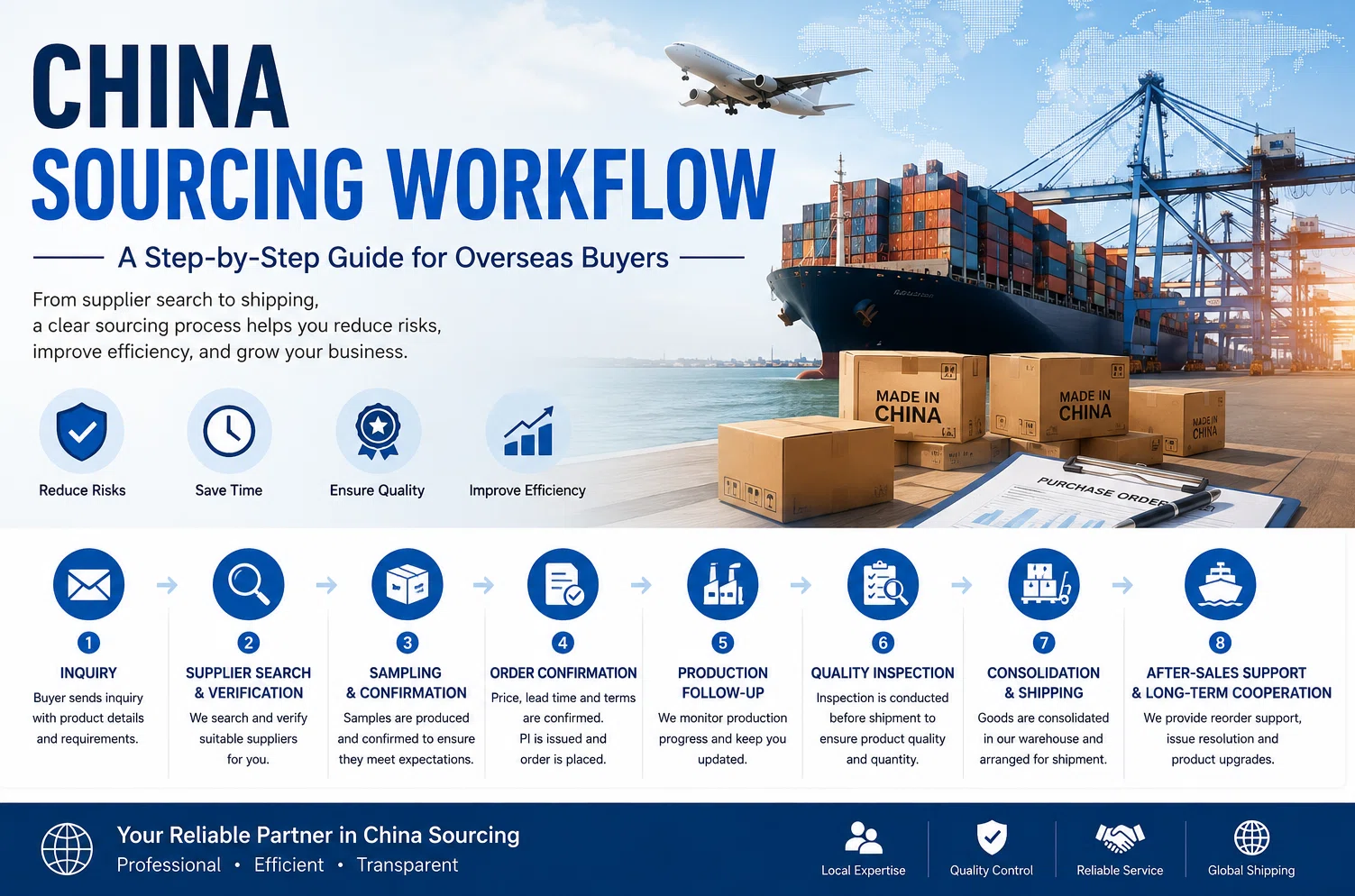
In this guide, we show how our china sourcing workflow works from inquiry to shipment.
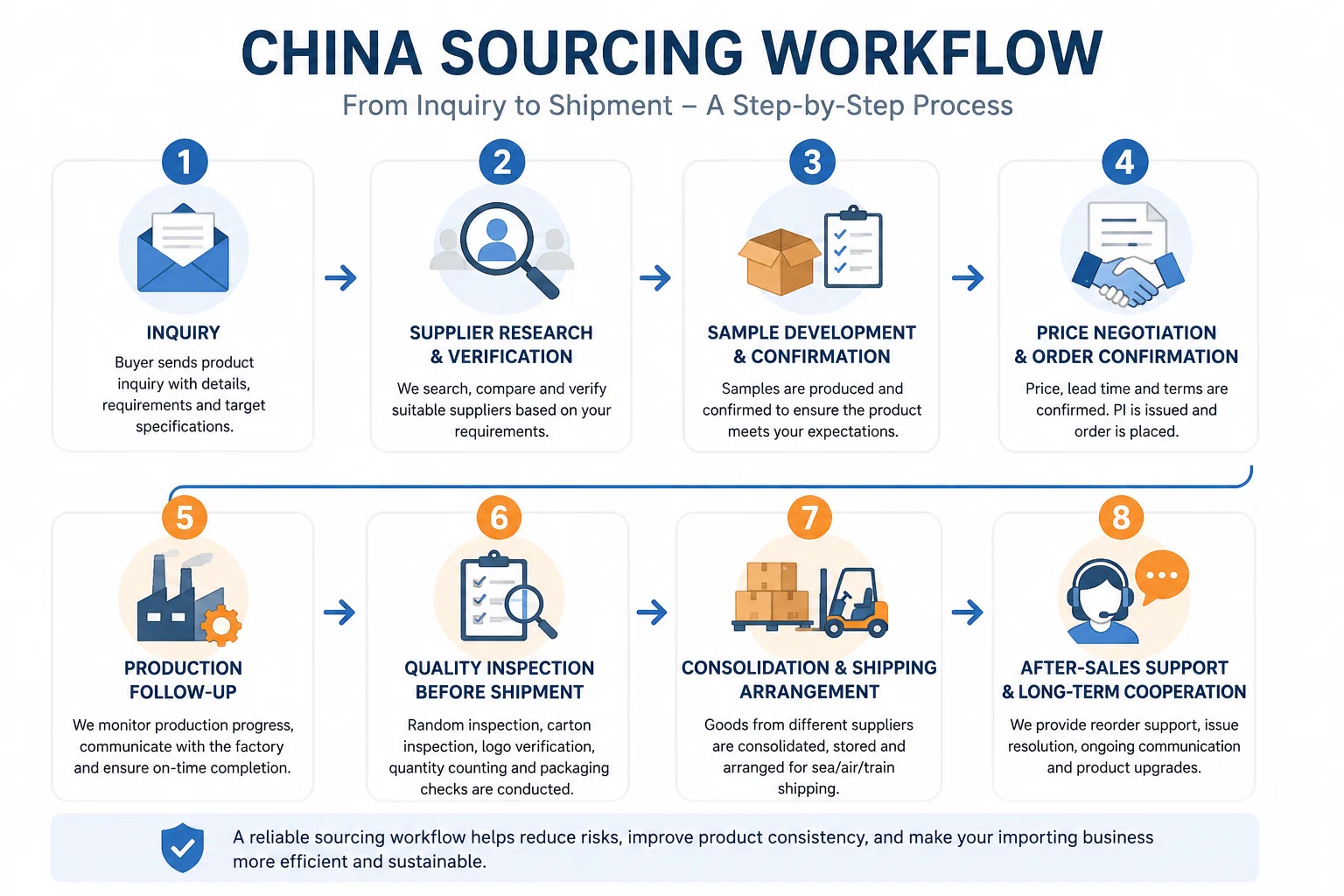
Step 1 – Understanding Buyer Requirements
Every sourcing project starts with understanding the buyer’s actual product requirements. Before searching for suppliers, it is important to clarify details such as product specifications, target market, expected order quantity, customization needs, packaging preferences, and budget expectations.
For example, buyers selling through supermarkets may focus more on packaging compliance and barcode requirements, while ecommerce sellers often pay closer attention to product appearance, branding, and low MOQ options.
At this stage, our team usually collects information including product images, dimensions, materials, logo requirements, certification needs, and target pricing. Clear communication in the beginning helps avoid misunderstandings later during sampling and production.
Many sourcing problems actually start with unclear product requirements. The more details buyers provide in the beginning, the faster and more accurately suppliers can be matched.
In some cases, buyers may not yet have complete product specifications. In that situation, sourcing agents can also help recommend suitable materials, packaging solutions, or manufacturing options based on the buyer’s market and budget.
Step 2 – Supplier Research and Verification
After confirming the buyer’s requirements, the next step is supplier research and verification. This stage is not simply about finding factories with the lowest prices. The goal is to identify suppliers that can consistently meet quality expectations, production timelines, customization requirements, and communication standards.
In many product categories, multiple suppliers may offer similar products, but their manufacturing capability, material quality, and production experience can vary significantly. Because of this, supplier screening is one of the most important parts of the sourcing process.
Our team usually compares suppliers based on factors such as product specialization, quotation structure, production capacity, certification availability, export experience, and response efficiency. Communication speed and transparency are also important indicators when evaluating long-term cooperation potential.
Common Supplier Verification Factors
| Verification Area | What We Usually Check |
| Production capability | Factory scale, equipment, production stability |
| Product quality | Materials, workmanship, sample consistency |
| Certifications | CE, FDA, LFGB, CPSIA, test reports |
| Export experience | Previous overseas orders and packaging standards |
| Communication efficiency | Response speed and problem-solving ability |
| Quotation structure | Material details, packaging costs, hidden differences |
For certain products, we may also request production photos, review previous export records, or conduct factory visits when necessary. This helps reduce risks related to inconsistent quality, delayed production, or inaccurate product claims.
Experienced buyers understand that the lowest quotation is not always the best option. Stable quality, reliable communication, and production consistency often create more long-term value.
Step 3 – Sample Development and Confirmation
Once suitable suppliers are selected, the next stage is sample development and confirmation. Sampling plays a critical role in the sourcing process because it allows buyers to verify product details before moving into mass production.
At this stage, buyers typically review elements such as material quality, product dimensions, color consistency, logo printing, packaging appearance, and overall workmanship. For customized products, samples are especially important for confirming branding details and avoiding misunderstandings during production.
Depending on the product category, samples may also include functionality testing, durability checks, or packaging drop tests. Small adjustments made during the sampling stage can often prevent much larger problems later during bulk production.
Sample Confirmation Checklist
- Logo printing position and accuracy
- Material and color confirmation
- Product dimensions and functionality
- Retail packaging appearance
- Barcode labels and carton marks
- Instruction manuals and accessories
For example, differences in material thickness, logo positioning, color matching, or packaging structure may seem minor initially, but they can significantly affect the final product presentation and customer experience.
Many bulk order problems can actually be identified during the sampling stage before production officially begins.
Many experienced importers treat sampling as a quality control step rather than just a product preview. A well-confirmed sample helps suppliers understand buyer expectations more clearly and creates a more reliable production standard for future orders.
Step 4 – Price Negotiation and Order Confirmation
After sample approval, the sourcing process moves into price negotiation and order confirmation. At this stage, both buyers and suppliers finalize important commercial and production details before mass production begins.
Negotiation is not only about discussing product pricing. It also includes confirming MOQ requirements, production lead times, packaging specifications, customization details, payment terms, and shipping arrangements. Clear confirmation at this stage helps reduce misunderstandings and production delays later.
Depending on the supplier and product category, MOQ flexibility may vary significantly. In some cases, buyers may negotiate lower quantities for trial orders, while larger orders often allow more competitive pricing and customized packaging options.
Important Details Confirmed Before Production
| Area | Typical Confirmation Items |
| MOQ | Trial order quantity, carton quantity |
| Lead time | Production schedule and delivery timeline |
| Packaging | Carton size, barcode labels, retail packaging |
| Payment terms | Deposit structure and balance payment |
| Shipping method | Sea freight, air freight, railway shipping |
| Customization | Logo printing, color, packaging details |
Production lead time is another important factor. Buyers usually need to balance delivery schedules with manufacturing capacity, especially during peak sourcing seasons when factory workloads increase.
Packaging details are commonly reviewed again before order confirmation, including carton sizes, shipping marks, barcode labels, and retail packaging structure. These details are especially important for ecommerce sellers, supermarkets, and retail chains that require consistent packaging standards.
Professional sourcing is not only about getting lower prices. It is also about balancing quality, delivery time, and supplier reliability.
In many cases, stable production management and clear communication create more long-term value than simply choosing the lowest quotation. Once all details are confirmed, suppliers can begin bulk production according to the approved sample and agreed specifications.
Step 5 – Production Follow-Up
Once mass production begins, production follow-up becomes one of the most important parts of the sourcing process. Even after pricing, samples, and order details are confirmed, ongoing communication and schedule management are still necessary to keep production running smoothly.
During this stage, sourcing teams usually stay in regular contact with factories to monitor production progress, confirm production schedules, and coordinate any updates related to materials, packaging, or delivery timelines.
In many cases, production delays are not caused by a single major problem. Small issues such as material shortages, packaging changes, printing adjustments, or supplier scheduling conflicts can gradually affect shipment timelines if they are not handled early.
Common Tasks During Production Follow-Up
| Area | Typical Follow-Up Work |
| Production updates | Monitoring manufacturing progress and completion status |
| Factory communication | Daily or weekly coordination with suppliers |
| Schedule monitoring | Tracking production timelines and shipment deadlines |
| Packaging coordination | Confirming packaging materials, labels, and carton details |
| Problem solving | Handling delays, printing issues, or material adjustments |
| Shipping preparation | Coordinating booking schedules and warehouse planning |
For customized products, production follow-up is especially important because even small production inconsistencies may affect the final order result. Logo printing, packaging layout, color matching, and accessory preparation often require additional coordination during production.
Factories may also encounter unexpected situations during manufacturing, especially during busy seasons. In these situations, timely communication helps buyers adjust schedules, solve production issues earlier, and reduce the risk of delayed shipments.
Effective sourcing management is not only about placing orders. It is also about maintaining stable communication and solving problems throughout the production process.
Packaging coordination is another important part of this stage. Carton sizes, barcode labels, shipping marks, retail packaging, and pallet requirements may all need final confirmation before goods are prepared for shipment.
Many experienced importers understand that production follow-up directly affects delivery reliability. Without regular monitoring and communication, even previously confirmed orders may still face avoidable delays or packaging mistakes before shipment.
Step 6 – Quality Inspection Before Shipment
Before products are shipped, the next critical stage is quality inspection. This process helps buyers verify whether the finished goods match the approved samples, packaging requirements, and order specifications before cargo leaves the factory.
Pre-shipment inspection is especially important for international orders because correcting problems after shipment is often far more expensive and time-consuming than identifying issues before delivery.
During inspection, products are usually checked based on random sampling standards rather than inspecting every single item individually. This helps evaluate overall production consistency and identify potential quality risks within the batch.
Common Inspection Areas Before Shipment
| Inspection Area | What Is Usually Checked |
| Product appearance | Scratches, color consistency, workmanship |
| Logo verification | Printing accuracy, logo position, branding details |
| Functionality testing | Product usage, moving parts, accessories |
| Quantity counting | Carton quantity and total production quantity |
| Carton inspection | Carton condition, carton size, shipping marks |
| Packaging checks | Barcode labels, retail packaging, instruction manuals |
For customized products, logo printing and packaging verification are often among the most important inspection points. Small issues such as incorrect barcode labels, printing errors, missing accessories, or damaged packaging can create major problems after products reach overseas warehouses or retail stores.
Carton inspection is also an important part of shipment preparation. Inspectors may check carton strength, carton dimensions, labeling accuracy, and loading suitability to help reduce transportation risks during international shipping.
Many buyers only discover problems after goods arrive. Pre-shipment inspection helps reduce this risk significantly.
In some cases, inspection may also identify production inconsistencies between different batches, especially for products involving manual assembly, printing, or customized packaging. Early detection allows suppliers to make corrections before shipment arrangements are finalized.
Many experienced importers treat inspection as an essential risk-control step rather than an optional service. A reliable inspection process helps improve shipment consistency, reduce disputes, and create more stable long-term supplier cooperation.
Step 7 – Consolidation and Shipping Arrangement
After inspection is completed, the next stage is consolidation and shipping arrangement. For many overseas buyers, especially those purchasing from multiple suppliers, this part of the sourcing process is essential for improving shipping efficiency and controlling logistics costs.
In Yiwu and other major sourcing regions, buyers often purchase products from different factories at the same time. Instead of arranging separate shipments for each supplier, goods can be consolidated into one shipment through warehouse coordination and container planning.
Common Logistics Coordination Tasks
| Area | Typical Arrangement |
| Supplier consolidation | Collecting products from multiple factories |
| Warehouse storage | Temporary storage before shipment |
| Mixed container loading | Combining different products into one container |
| Shipping documents | Packing lists, invoices, labels, export documents |
| Freight arrangement | Sea freight, air freight, railway shipping |
| Shipment scheduling | Booking containers and coordinating delivery timelines |
For buyers sourcing multiple product categories, mixed container consolidation can significantly reduce shipping costs and simplify logistics management. This is especially useful for supermarkets, ecommerce sellers, wholesalers, and retail importers purchasing from several suppliers simultaneously.
Warehouse coordination also plays an important role during this stage. Products from different suppliers may arrive at different times, so temporary storage and shipment scheduling help ensure goods are prepared together before container loading.
Shipping documents are another critical part of international sourcing. Incorrect carton labels, missing invoices, or inaccurate packing lists can create customs clearance problems and delivery delays. Because of this, documentation is usually checked carefully before shipment booking is finalized.
Common Shipping Methods
- Sea freight for large-volume and cost-sensitive orders
- Air freight for urgent or lightweight products
- Railway shipping for certain regional markets
- Combined logistics solutions for mixed sourcing projects
Efficient shipping management is not only about moving goods internationally. It is also about coordinating suppliers, packaging, warehouse timing, and logistics schedules together.
Depending on the buyer’s budget, destination, and delivery timeline, different freight solutions may be selected. Some buyers prioritize lower shipping costs, while others focus more on faster delivery or flexible inventory planning.
For long-term importers, reliable consolidation and logistics coordination help simplify the entire supply chain process and reduce operational complexity when sourcing from multiple suppliers in China.
Step 8 – After-sales Support and Long-term Cooperation
For many buyers, the sourcing process does not end after shipment leaves the warehouse. Long-term sourcing success often depends on consistent supplier communication, reliable after-sales support, and continuous product improvement over time.
After delivery, buyers may need support with reorders, packaging adjustments, product updates, or supplier coordination for future purchasing plans. Maintaining stable communication after shipment helps improve sourcing efficiency and reduces repeated problems in future orders.
Common After-sales Support Areas
| Area | Typical Support |
| Reorder support | Repeat production and order scheduling |
| Supplier communication | Ongoing factory coordination and follow-up |
| Issue resolution | Handling quality concerns or shipment problems |
| Product upgrades | Packaging improvements, material updates, new versions |
| Inventory planning | Coordinating future purchasing schedules |
| Market adjustments | Adapting products for changing buyer requirements |
In some cases, buyers may request modifications after the first production run. This can include changes to packaging structure, logo printing, product materials, accessories, or carton configuration based on customer feedback or market performance.
For long-term buyers, supplier relationships also become more stable over time. Factories that understand the buyer’s quality expectations, packaging standards, and production preferences can usually support future orders more efficiently and consistently.
Long-term sourcing cooperation is not only about placing repeat orders. It is also about improving communication efficiency, product consistency, and supply chain stability over time.
Issue resolution is another important part of after-sales support. Occasionally, buyers may encounter shipment delays, packaging problems, or product inconsistencies after delivery. Fast communication between sourcing teams and suppliers helps identify solutions more efficiently and reduces operational disruption.
Product upgrades are also common in long-term sourcing projects. As market trends and customer preferences change, buyers may introduce new packaging designs, updated materials, additional accessories, or improved product functions to remain competitive in their target markets.
Many experienced importers view sourcing as an ongoing partnership rather than a one-time transaction. Stable supplier cooperation and continuous optimization often create better long-term results than frequently changing factories based only on short-term pricing differences.
Step 8 – After-sales Support and Long-term Cooperation
For many buyers, sourcing does not end once the shipment is delivered. Long-term cooperation and ongoing supplier management are also important parts of building a stable supply chain.
After the first order is completed, buyers often need support with repeat orders, packaging adjustments, product improvements, or communication with suppliers for future purchasing plans. Maintaining consistent follow-up after shipment helps improve efficiency and reduces repeated sourcing problems later.
Common After-sales Support Areas
| Area | Typical Support |
| Reorder support | Repeat production scheduling and inventory planning |
| Supplier communication | Ongoing factory coordination and production follow-up |
| Issue resolution | Handling quality concerns or shipment-related problems |
| Product upgrades | Packaging updates, material improvements, new product versions |
| Order optimization | Improving packaging efficiency or reducing production issues |
| Long-term cooperation | Building more stable supplier relationships over time |
In some cases, buyers may request changes after the first production run based on customer feedback or market performance. This may include updating logo printing, adjusting packaging structures, improving product materials, or developing new product variations for future orders.
Supplier communication also becomes more efficient during long-term cooperation. Factories that already understand the buyer’s quality standards, packaging preferences, and production expectations can usually handle repeat orders more smoothly and consistently.
Many experienced importers view sourcing as a long-term partnership rather than a one-time transaction.
Issue resolution is another important part of after-sales support. Occasionally, buyers may encounter packaging concerns, shipment delays, or product inconsistencies after delivery. Fast communication between sourcing teams and suppliers helps identify solutions more efficiently and minimizes operational disruption.
Product upgrades are especially common in competitive retail and ecommerce markets. As trends and customer expectations change, buyers may gradually improve packaging design, materials, functionality, or branding to stay competitive in their target markets.
In the long run, stable supplier relationships and continuous product optimization often create better business results than frequently changing suppliers based only on short-term pricing differences.
Common Challenges During China Sourcing
Even with careful planning, China sourcing projects may still encounter unexpected challenges during production and shipping. Understanding these common issues helps buyers prepare more effectively and reduce sourcing risks before they become larger problems.
In many cases, sourcing difficulties are not caused by a single major mistake. Small communication gaps, packaging misunderstandings, or production inconsistencies can gradually affect delivery schedules and final product quality if they are not managed properly.
Common Challenges Buyers May Face
| Challenge | Typical Situation |
| Production delays | Material shortages or factory scheduling conflicts |
| Wrong packaging | Incorrect labels, carton marks, or retail packaging |
| Communication misunderstandings | Differences in specifications or production expectations |
| Quality inconsistency | Variations between samples and bulk production |
| Shipping schedule changes | Delayed booking or container availability issues |
| Customization errors | Incorrect logo printing or color differences |
Production delays are one of the most common sourcing challenges, especially during busy manufacturing seasons. Factory workloads, raw material shortages, or packaging preparation delays can all affect production timelines and shipment schedules.
Packaging mistakes are another frequent issue during international sourcing. Incorrect barcode labels, missing instruction manuals, wrong carton dimensions, or inaccurate shipping marks may create problems during customs clearance, warehouse receiving, or retail distribution.
Communication misunderstandings can also happen when product specifications are not clearly confirmed at the beginning of the project. Small details such as material thickness, logo placement, accessory configuration, or packaging structure may sometimes be interpreted differently between buyers and suppliers.
Many sourcing problems are not caused by bad suppliers alone. Incomplete communication and unclear production details can also create avoidable risks during manufacturing.
Quality inconsistency is another important concern, particularly for customized products or repeat orders produced across different batches. Differences in materials, workmanship, or printing quality may appear if production standards are not monitored consistently.
Experienced buyers usually understand that sourcing management is not only about placing orders. Continuous communication, production follow-up, inspection, and logistics coordination all play important roles in reducing operational risks throughout the sourcing process.
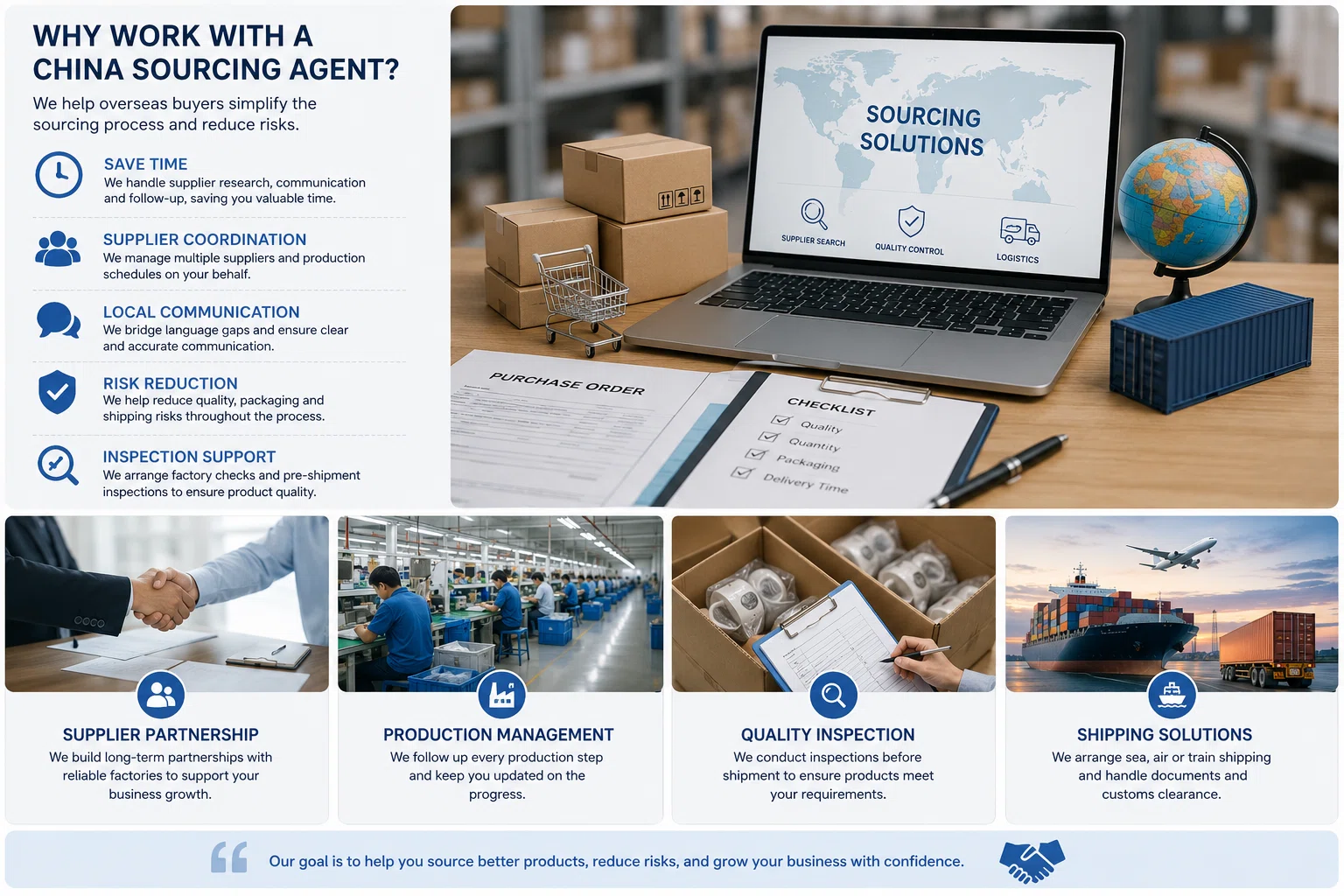
Why Many Buyers Work With a China Sourcing Agent
For many overseas buyers, sourcing from China involves much more than simply finding products online. Managing suppliers, confirming production details, following up on schedules, arranging inspections, and coordinating shipping can become time-consuming and difficult, especially when working with multiple factories.
Because of this, many importers choose to work with a China sourcing agent to simplify the process and reduce operational risks throughout the supply chain.
Common Reasons Buyers Use Sourcing Agents
| Area | How Sourcing Agents Help |
| Time saving | Reducing time spent searching and communicating with suppliers |
| Supplier coordination | Managing multiple factories and production schedules |
| Local communication | Handling language differences and factory follow-up |
| Risk reduction | Reducing quality, packaging, and shipment problems |
| Inspection support | Organizing product checks before shipment |
| Logistics coordination | Managing consolidation and shipping arrangements |
One of the biggest advantages of working with a sourcing agent is local coordination. Communicating directly with factories across different time zones, languages, and production systems can sometimes slow down sourcing projects. Local sourcing teams help bridge this communication gap and keep production moving more efficiently.
Supplier coordination is another important factor, especially for buyers sourcing from multiple factories. Managing quotations, production schedules, packaging standards, inspections, and shipment timelines across several suppliers can quickly become complicated without local support.
Many buyers discover that successful sourcing depends not only on product pricing, but also on communication efficiency, production management, and risk control.
Inspection support is also one of the most valuable services during international sourcing. Buyers who cannot visit factories personally often rely on sourcing teams to monitor production, check packaging details, verify product quality, and coordinate shipment preparation before goods leave China.
For growing businesses, sourcing agents may also help improve long-term supply chain stability. Over time, buyers can build more reliable supplier networks, optimize shipping arrangements, and improve sourcing efficiency through ongoing cooperation and local market experience.
Rather than acting only as middlemen, experienced sourcing agents often function as local supply chain partners who help buyers manage sourcing, production, inspection, and logistics more effectively throughout the entire importing process.
FAQ – China Sourcing Workflow
1. How long does the China sourcing process usually take?
The sourcing timeline depends on product complexity, customization requirements, and order quantity. In general, the full process from supplier sourcing to shipment can take between 3 to 6 weeks for most standard products. Customized products may require additional time for sampling and production adjustments.
2. Can I source products from multiple suppliers in one order?
Yes. Many buyers source products from multiple factories. In this case, consolidation is often used to combine different products into one shipment. This helps reduce shipping costs and simplifies logistics management.
3. What happens if the sample is not approved?
If the sample does not meet requirements, adjustments can be made based on feedback. This may include changes in materials, packaging, logo placement, or product structure. Multiple revisions may be required before final approval for mass production.
4. Do I need to visit China to complete sourcing?
No, visiting China is not necessary. A sourcing agent can handle supplier communication, sampling, production follow-up, inspection, and shipping coordination on behalf of the buyer. However, some buyers still choose to visit for large or complex projects.
5. How do you ensure product quality before shipment?
Quality is usually ensured through pre-shipment inspection. This includes random product checks, carton inspection, quantity counting, logo verification, and packaging review before goods are shipped from the factory or warehouse.
6. What if there are delays during production?
Production delays may happen due to material shortages, peak season workload, or packaging issues. In such cases, sourcing teams monitor factory progress and communicate directly with suppliers to adjust schedules and minimize delays.
7. What shipping methods are available for China sourcing?
Common shipping methods include sea freight, air freight, and railway transportation. The choice depends on order volume, delivery urgency, and budget requirements. Some buyers also use mixed logistics solutions for different product categories.
8. Why do many buyers use sourcing agents instead of contacting factories directly?
Working with factories directly can be challenging due to communication barriers, supplier verification difficulties, and logistics coordination issues. Sourcing agents help manage supplier communication, quality control, inspection, and shipping arrangements, making the process more efficient and less risky.
Conclusion
China sourcing involves much more than simply finding a factory online. A reliable sourcing workflow helps buyers reduce risks, improve product consistency, and manage shipping more efficiently across different suppliers and production stages.
In practice, challenges such as supplier differences, sampling adjustments, production delays, and packaging inconsistencies are all part of the sourcing process. Having a structured workflow helps make each step more manageable and predictable.
At YiwuAgent, we work with overseas buyers to support the full sourcing process — including supplier research, sampling coordination, production follow-up, quality inspection, and shipment arrangement.
If you are currently planning to source products from China, having a structured sourcing process in place can make the entire journey more efficient and less risky.
View Related Content